
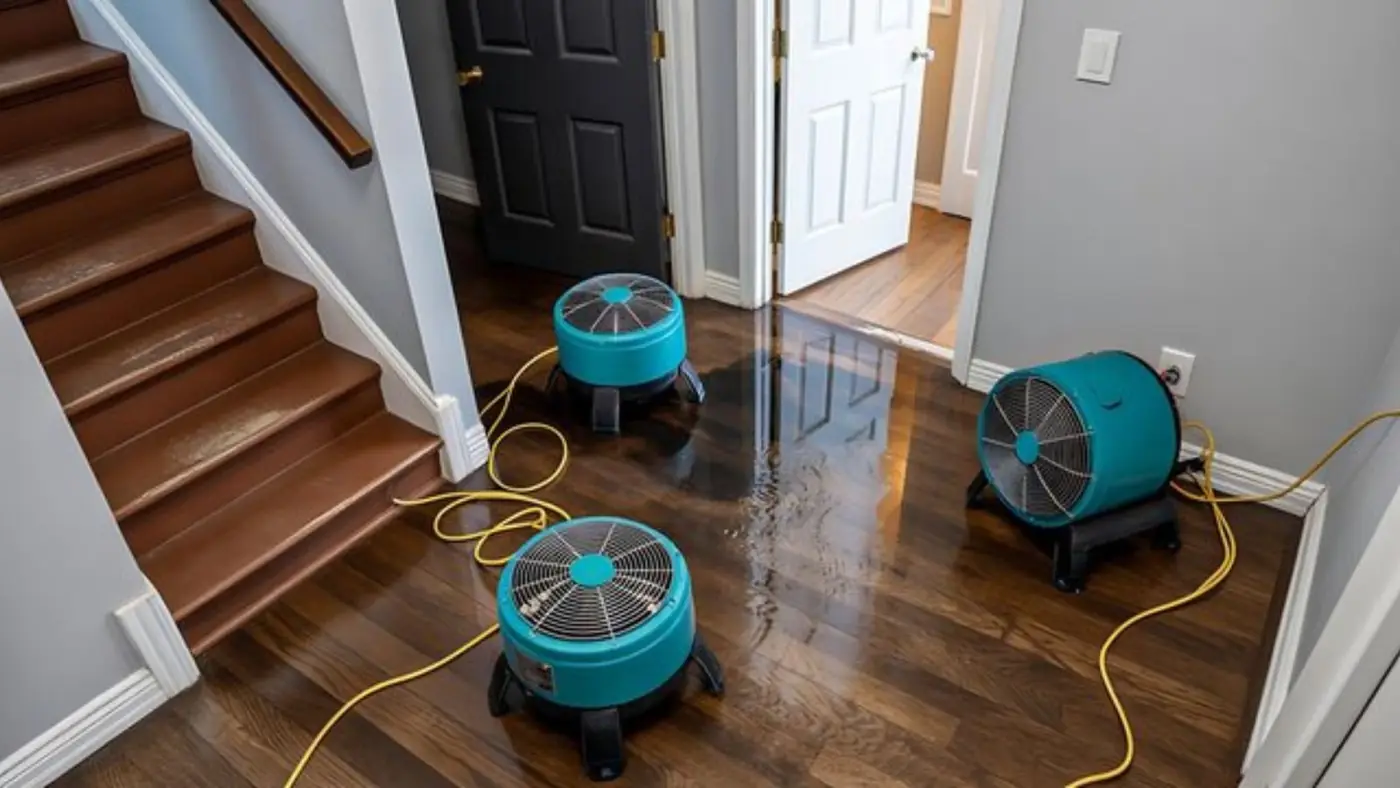
Water damaged hardwood floors in Broomfield, CO can often be saved if the water source is stopped and the boards and subfloor are dried in a controlled way. Whether a floor is saved or replaced depends on how long it stayed wet, what the boards are made of and how far the damage has progressed. Moisture readings, not appearance, settle the question.
The short answer
Early, slow, measured drying saves more floors than fast heat or guesswork.
- Cupped boards often settle once they dry.
- Boards that lift off the subfloor, called buckling, are usually replaced.
- Wait for dry readings before any sanding.
Cupping, Crowning and Buckling: The Three Stages
Cupping
The edges of each board rise higher than the center. It usually means moisture reached the underside, and it often improves as the wood dries.
Crowning
The center of the board rises above the edges. It can show up after a cupped floor is sanded too early, or when the top surface was wetter than the bottom.
Buckling
Boards pull up from the subfloor, sometimes in a ridge. This is the most serious stage, and replacement is common.
Gapping
Boards shrink and separate as they dry. Some gaps close as humidity changes, and others remain.
These stages are on a spectrum, not a checklist. A floor can cup in one corner while the rest is fine. The goal is to find where moisture sits and whether the boards can return to a flat plane.
Species, Construction and Why They Matter
Solid hardwood and engineered hardwood behave differently. Solid boards swell with moisture and can usually be refinished more than once. Engineered boards have a thin top layer of real wood over layers underneath, so their sand and refinish potential depends on how thick that top layer is.
Species and plank width play a role too. Wider planks move more than narrow ones, and some species are more stable than others. A flooring professional can identify what you have, and the answer shapes whether refinishing is realistic after drying.
How We Measure Before Anyone Decides
- Stop the source and remove standing water so the floor stops taking on more moisture.
- Read the boards and the subfloor with moisture meters, since the top surface can mislead.
- Use thermal imaging to find damp areas that the meter has not reached.
- Set air movers and LGR dehumidifiers to dry the floor gradually. Drying that is too fast can crack or split boards.
- Track readings until the wood and subfloor match an unaffected reference area.
- Reassess. Only then decide between sanding, partial replacement or full replacement.
Floor lifting or cupping?
Call the 24/7 line and describe it. We explain scope and price before work starts.
Refinish or Replace: A Decision Table
| What you see | After controlled drying | Typical decision |
|---|---|---|
| Mild cupping, no lifting | Often flattens | Wait for dry readings, then sand and refinish |
| Cupping in a room, finish cracked | May flatten, finish needs work | Refinish, with an eye on remaining thickness |
| Buckling or boards lifted from subfloor | Rarely returns to flat | Replace the affected area |
| Black or dark staining in the wood | Not removed by drying alone | Remove affected boards and check below |
| Wet subfloor under a floating floor | Needs access to dry | Lift the flooring and dry the subfloor first |
Moisture readings and a flooring professional decide the final call.
When the Water Is Under the Floor
Many hardwood problems start below the boards. A leaking dishwasher line, a washer valve, a refrigerator ice-maker line or a slab that sweats can wet the subfloor for a long time before the surface changes. By the time cupping shows up, the moisture has often been there a while.
That is why a visible symptom should lead to a moisture survey, not a guess. If the subfloor is wet, the boards may need to come up in sections so air can reach the underside. Pulling a few boards to dry the cavity is often a better outcome than replacing the whole room later.
What You Can Do While You Wait
- Remove rugs, mats and furniture legs that trap moisture on the surface.
- Lift standing water with towels or a wet vac, but avoid scrubbing, which pushes water into seams.
- Do not tape plastic over the floor. It traps humidity against the boards.
- Take photos of the cupping from a low angle in raking light, which shows the profile.
These steps hold the situation steady until readings are taken. They do not replace professional drying. If water reached outlets or baseboard heaters, phone your utility or 911 about the electrical risk before anything else.
Why Patience Before Sanding Pays Off
A floor that feels dry on top can still hold moisture below. Sanding too early removes wood from boards that might have settled on their own. It can also lock in crowning once the boards finish drying.
Wait until readings show the wood and subfloor are dry and stable. Flooring contractors usually want this too, and they may ask for a drying record. Keep it with your other paperwork.
What We Do and Do Not Do
We stop the damage and dry the structure. We handle tear-out and, through our water damage repair team, the rebuild work. Plumbing and basement waterproofing are not what we do. If a dishwasher or supply line leaked, a plumber fixes the cause.
Drying a wet floor is the core of our water mitigation work. If the water has gone past the floor into walls, flood damage restoration covers the larger scope. Ask whoever dries your floor which published standard the crew follows.
Broomfield note: home value and winter entries
Census QuickFacts reports that 62.7 percent of Broomfield housing is owner-occupied, with a median owner-occupied home value of $664,500 for 2020 to 2024. For most households, flooring is part of a home value decision, so document the floor before any work and keep the drying record. A buyer or appraiser may later ask what was done, and your records answer that.
NWS Denver/Boulder data shows seasonal snowfall of 56.9 inches, so for much of the year snowmelt tracked through entries onto hardwood is a steady source of small water events. Put mats at doors, wipe up melt promptly and watch the boards by the entry for early cupping.
Insurance and Paperwork
Insurers commonly separate a one-time burst from a slow leak that went unnoticed. Photograph the floor before work starts and keep moisture readings. Check your policy and ask your insurer, because we cannot promise how any claim is decided.
If the floor gets a partial replacement, matching stain and finish takes planning. Ask the flooring contractor to show a sample on your own boards. We also respond to calls in Louisville and Erie, and our home market is ZIPs 80020, 80021 and 80023.
Often it improves once the boards and subfloor dry, but not always. The source of water, how long it was wet and the board type all matter. Wait for dry readings before you decide on sanding.
Sometimes. Engineered boards have a thin wear layer over other layers, and moisture can separate them. A moisture reading and a flooring professional give you a realistic answer.
Do not push heat at the floor. Fast, uneven drying can crack or split boards, and fans alone can leave moisture below. Controlled drying with air movers and dehumidifiers is slower and safer.
NWS Denver/Boulder data shows a snow season that runs from October into April. That means months of snowmelt at the door. Use mats, wipe up wet spots and watch the entry boards.
Drywall and flood repairs need city permits. Flooring alone may differ, so ask the Building Division before a rebuild.
Water or mold in your home right now?
Call the 24/7 line and describe what you see. We explain scope and price before work starts.